NGIN Releases New Research and Action Guide on Regional Engagement in Technology-Based Economic Development
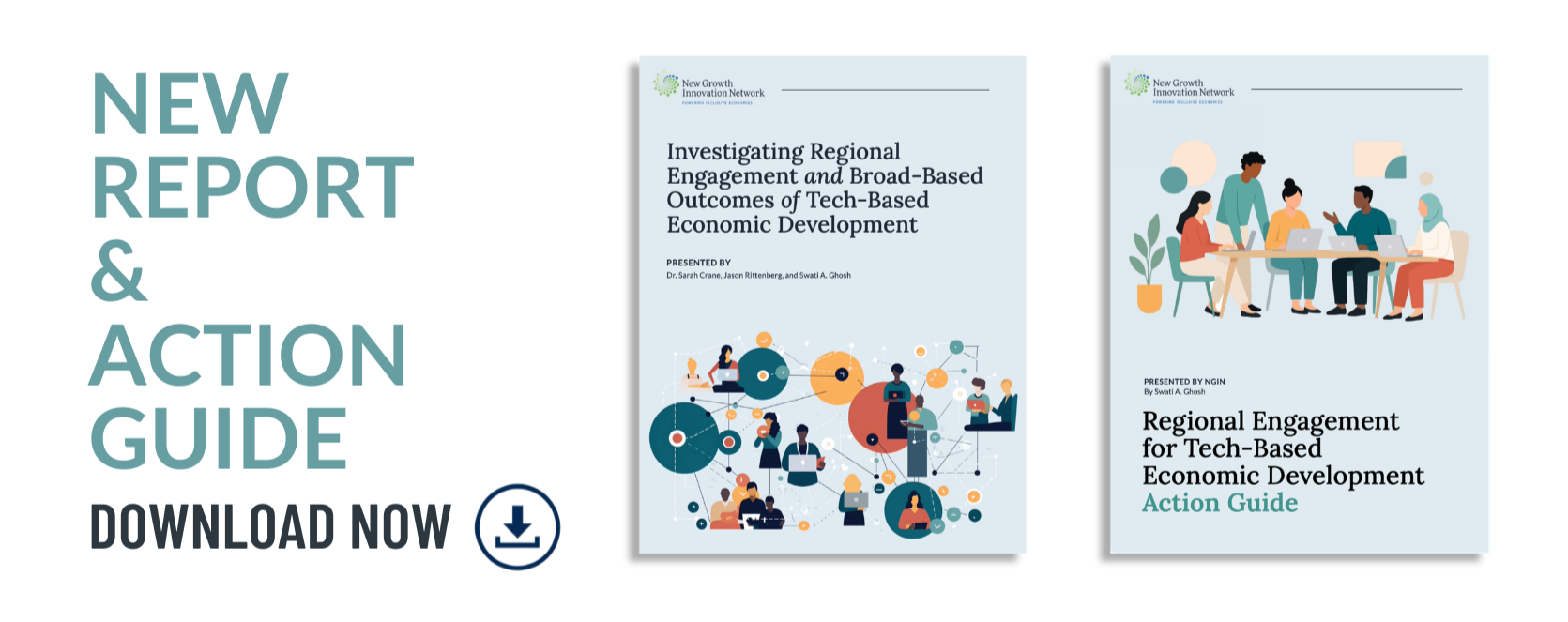
New Growth Innovation Network (NGIN) is pleased to announce the release of two new resources examining how regions can strengthen engagement and broaden participation in technology-based economic development (TBED): Investigating Regional Engagement and Broad-Based Outcomes of Tech-Based Economic Development Report and the Regional Engagement for Tech-Based Economic Development Action Guide.
The project explores how regions can ensure that innovation investments create benefits that reach beyond traditional technology and research ecosystems and create opportunities for a broader range of residents, organizations, and institutions to participate in and benefit from economic growth.
The resources were developed through a National Science Foundation-supported research project led by Swati A. Ghosh, Vice President of Insights and Innovations at NGIN, and Dr. Sarah R. Crane, Founder and Principal of Restorative Economics Group, with support from SSTI and the University of Michigan Economic Growth Institute.
About NSF Engines
The research was conducted alongside the U.S. National Science Foundation's Regional Innovation Engines (NSF Engines) program, an initiative designed to spur growth in regions that have not fully participated in the advanced technology economy. NSF Engines supports regional coalitions working to accelerate research, commercialize new technologies, and strengthen workforce development pathways.
Interest in NSF Engines has been substantial. As of January 2026:
9 regions were selected from 188 proposals to receive initial NSF Engines awards of $15 million, with each region eligible for up to an additional $145 million in funding.
15 regions were named finalists for a second round of NSF Engines awards.
58 regions received NSF Engines Development Awards of up to $1 million each.
The two NSF Engines featured in this research, the Florida Semiconductor Engine and the Regenerative Medicine Engine in North Carolina, are among the program's inaugural awardees.
About the Research
Using a qualitative research approach, the team conducted interviews and small-group discussions during Fall 2025 with residents, economic development practitioners, workforce development leaders, educators, and community-based organizations in the regions surrounding the two NSF Engines. Community navigators in both Florida and North Carolina supported outreach and participant recruitment. In total, 35 individuals participated in the study.
Some key insights from the research are:
Broad-based outcomes from TBED initiatives don’t emerge automatically from innovation investments alone. They depend on intentional connection from innovation ecosystems to the broader communities they operate in.
Even though TBED investments can be hard to translate into simple to understand language, and community stakeholders may not be fully aware of the scope and scale of impacts to come from these investments, communities seek to understand the opportunities and pathways for participation.
Trusted intermediaries are critical “bridges” between community stakeholders and innovation leaders. They can help spread awareness and translate technical concepts for community members. They also enable innovation leaders to better align strategies with local realities and priorities.
As such, intermediaries and functions performed by local organizations in TBED initiatives should be recognized and supported accordingly to ensure broader prosperity for the community from TBED initiatives.
New Resources Available
The resulting report, Investigating Regional Engagement and Broad-Based Outcomes of Tech-Based Economic Development, presents findings from the research and contributes to a growing body of knowledge on how innovation investments can connect with communities beyond traditional technology and research ecosystems.
The accompanying Regional Engagement for Tech-Based Economic Development Action Guide translates those findings into tools designed to help practitioners strengthen engagement efforts, build community relationships, and create pathways for broader participation in innovation-driven economic development.
Together, these resources are intended to support economic development organizations, workforce development leaders, educators, local governments, community-based organizations, funders, and others working to ensure that innovation investments create opportunities that reach more people and places.
Written by: Taylor Dudley, Marketing and Communications Manager, NGIN