AI Is Not the Future of Economic Development. It Is a Test of How We Create Opportunity.
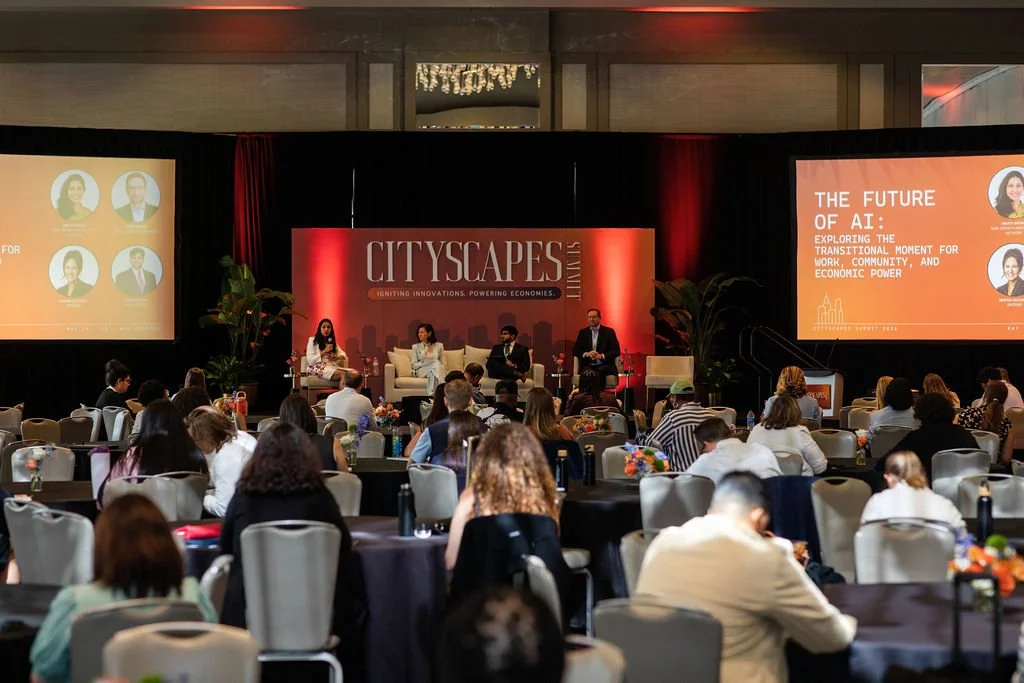
Insights from Cityscapes Summit 2026 Sessions: Making AI Work for Community and Economic Development | The Future of AI: Exploring the Transitional Moment for Work, Community, and Economic Power
By: Beka Burton, Advisor - NGIN
Talk of artificial intelligence was everywhere at Cityscapes Summit 2026, even in sessions where it wasn't the topic on the agenda. A conversation about workforce development would eventually circle back to AI. A discussion about entrepreneurship would turn toward automation and productivity tools. Conversations about local government capacity often landed on the same challenge: communities are being asked to make decisions about technologies that are evolving faster than most institutions can fully understand them.
Yet what stood out most was not technology itself. The deeper conversation was about power, participation, and preparedness—a theme echoed throughout the discussions by speakers like Serena Jezior (Greater Cleveland Works), Chanell Hasty (Accelerator for America), Rick Thomas, (Hopeworks), Archie Stewart, (City of Birmingham), John Irons (Siegal Family Endowment) Shalin Jyotishi (New America), Bertina Ceccarelli (nPower), Rodrick Miller (Miami Dade Beacon Council)and Swati Ghosh (New Growth Innovation Network).
For decades, economic developers have helped communities navigate periods of change brought on by globalization, automation, industrial transitions, and digital transformation. AI is different in some respects, but it raises a surprisingly familiar set of questions. Who benefits? Who gets left out? Who has a voice in shaping what comes next? Those questions feel especially urgent because AI is no longer arriving at our doorstep. It is already in the room.
Employers are incorporating AI into hiring and recruitment. Small businesses are using generative tools to handle marketing, customer engagement, and administrative tasks. Manufacturers continue to automate routine processes while increasing demand for workers who can manage increasingly sophisticated systems. Local governments are exploring how technology can streamline permitting, service delivery, and internal operations The conversation has changed from whether AI will influence local economies to whether communities are prepared to influence AI.
The New Divide Is Not Access. It Is Agency.
Economic developers have seen this movie before.
When broadband expansion became a national priority, the conversation centered on access. Communities without reliable internet struggled to participate in a rapidly digitizing economy. Over time, investments helped narrow some of those gaps, although many disparities remain. AI presents an additional challenge beyond access.
Cityscapes participants argued that the communities most likely to thrive will be those that develop the capacity to understand, shape, and apply these tools in ways that align with local priorities. In other words, the next divide may be less about access and more about agency.
That is not a simple task. Schools are stretched thin. Workforce organizations are focused on immediate labor market needs. Community-based organizations are working to address housing, transportation, childcare, and food security challenges. For many local leaders, finding the time and capacity to engage with rapidly evolving technologies can feel nearly impossible. Several promising examples shared during Cityscapes offered a practical path forward. Rather than creating standalone AI academies or specialized technology programs, organizations are embedding AI literacy into existing workforce and entrepreneurship efforts. Job seekers are learning how to use AI tools to strengthen resumes and prepare for interviews. Small business owners are experimenting with AI-powered marketing and customer service tools. Workforce programs are introducing participants to the technologies they are increasingly likely to encounter on the job.
The goal is not to turn everyone into software engineers. The goal is to ensure that workers and entrepreneurs understand how AI is reshaping the industries they already participate in. For practitioners, this suggests a useful reframing.

AI readiness is not primarily a technology strategy. It is a workforce strategy, a small business strategy, and an economic mobility strategy.
Governance Matters as Much as Innovation
Cityscapes also revealed a growing tension that many communities are beginning to confront: how do we evaluate the benefits and costs of AI-related investments? Data centers became a useful example.
The conversation quickly moved beyond traditional economic development questions about jobs, tax revenue, and incentives. AI infrastructure is forcing practitioners to ask a broader set of questions. Participants raised concerns about energy consumption, water usage, land use impacts, workforce readiness, and whether local residents would actually benefit from the investments being made.

These discussions reflect a broader shift in economic development practice. Increasingly, communities are asking not only how much investment a project generates, but who benefits from that investment and how value is distributed.
Several practical strategies emerged. Communities can use incentive agreements to encourage local hiring and workforce development. Community benefit agreements can help secure investments in infrastructure, public amenities, or educational opportunities. Local governments can establish expectations around environmental stewardship and community engagement before projects move forward.
The specific tools will vary by community. The larger lesson is that local leaders cannot afford to treat AI-related investments as purely technical decisions. Governance, accountability, and community benefit must be part of the conversation from the beginning.
Trust Remains the Most Important Infrastructure
For all the discussion about algorithms, automation, and innovation, one theme surfaced again and again: trust. Communities are not rejecting technology because they dislike innovation. More often, skepticism reflects lived experience. Residents have seen projects arrive with promises of jobs and opportunity only to produce uneven results. They have watched investments flow into neighborhoods without improving outcomes for the people who already live there. They have participated in planning processes where decisions seemed predetermined before community engagement began. That history matters.
Several Cityscapes participants argued that successful AI strategies will begin not with technology but with listening. Before discussing applications, platforms, or governance frameworks, communities need conversations about aspirations, concerns, and priorities. Some local leaders described surveying residents before developing AI-related policies and intentionally removing technical jargon from public engagement efforts. Instead of asking residents how they felt about artificial intelligence, they asked about the issues people cared about most: access to good jobs, affordable housing, transportation, healthcare, and economic opportunity. Those conversations often produce more meaningful insights than technology-focused discussions because they connect innovation to everyday realities.
What do residents want for their children?
What kinds of jobs do they hope to create?
What does economic security actually look like in their community?
What role should technology play in helping them get there?
These questions may seem indirect, but they ultimately determine whether innovation strategies gain traction or encounter resistance.
Trust is often treated as a soft issue in economic development, but it’s actually crucial infrastructure. Without trust, even promising ideas struggle to move forward.
What Communities Can Do Now

Out of the conversations held at Cityscapes, several practical actions emerged:
Integrate AI literacy into existing workforce, entrepreneurship, and education programs.
Use incentive agreements and community benefit negotiations to ensure major technology investments create local value.
Invest in durable skills such as communication, problem-solving, adaptability, and critical thinking.
Build on trusted local institutions – including libraries, community colleges, workforce boards, and community-based organizations.
Engage residents early and often, focusing first on community priorities rather than technology itself.
For local leaders, the path forward is unlikely to be found in chasing the latest technology trend. It will come from strengthening the institutions, partnerships, and community relationships that allow people to navigate change successfully. Communities that do this well will not simply adapt to AI. They will shape how technological innovation translates into economic opportunity, mobility, and shared prosperity for the people they serve. This isn’t just an AI strategy. It is inclusive economic development at its best.
More about NGIN’s Small and Midsized Cities Hub
Cityscapes Summit is New Growth Innovation Network's (NGIN) biennial economic development conference, bringing together community, economic development, and city leaders to ignite innovations and power economies. This work is supported through NGIN's Small and Midsized Cities (SMC) Hub, a program funded by the Robert Wood Johnson Foundation, that offers a suite of programs, technical assistance, resources, and tools to support economic and community leaders build healthy, thriving communities in cities with populations ranging from 50,000 to 500,000.
To access upcoming events, resources, and peer learning opportunities designed for small and mid-sized cities, consider joining the SMC Hub Community of Practice. Membership is free and open to practitioners nationwide. Join here.